Back home in Nigeria the light went out often. Not occasionally. Often. If the flashlight had not been charged, you had nothing. But there was always a lantern, and the lantern always worked.
I have not seen one in a long time and I still think about it, because it is the clearest picture I have of what a dependable tool is. It does not need the grid. It does not need permission. It is small, it is yours, and it is enough for the thing you actually need to do right now, which is see.
The worry that started it
A lot of people are concerned about AI, and a lot of the concern is fair. I am not going to litigate all of it here. The part that has been sitting with me is the power. The models we use every day run in buildings that burn an enormous amount of energy, mostly to stay cool, and every question you type gets routed to one of those buildings and back. That is true whether you asked it to summarise a contract or to fix the tone of a two line email.
My complete thought on that problem is here. It is ten seconds long and I stand by it.
So I started wondering what it would be like to have something downloaded. Locally. On the thing in your pocket. Not as a political statement, just as a question: can the small tasks stay small?
The phone can do this now
The honest answer a couple of years ago was no. The honest answer now is yes, for a surprising amount. The GPUs in the newer Pro phones are genuinely capable, Apple's unified memory means the model does not have to be copied around, and a quantised model of a billion or three billion parameters fits and runs at a speed that feels like typing.
That covers more than you would think. Write an email. Rewrite this so it is clearer. What is a word for this. Explain what this term means. Walk me through the first aid for this. None of those need a data center. They need something small, close, and available. Leave the big tasks to the big machines and let the little ones live on the phone.
I need a little something. I do not have Google. I do not have anything. What can I ask?
That last one is the situation I keep coming back to. You are outside. You are stuck. There is no signal, or you are somewhere the signal is not yours to use. You need a small answer and you need it now. An on the go model that anyone can open at any time, with no connection, is a real thing that could exist, and as far as I can tell not many people have it yet. It will get better over time. It is already useful.
What it is
Lantern runs a quantised model entirely on the iPhone through MLX. The only network call it ever makes is the one time download of public model weights. After that it works in airplane mode, and the screen shows what that costs while it writes: tokens per second, memory in use, thermal state, live.
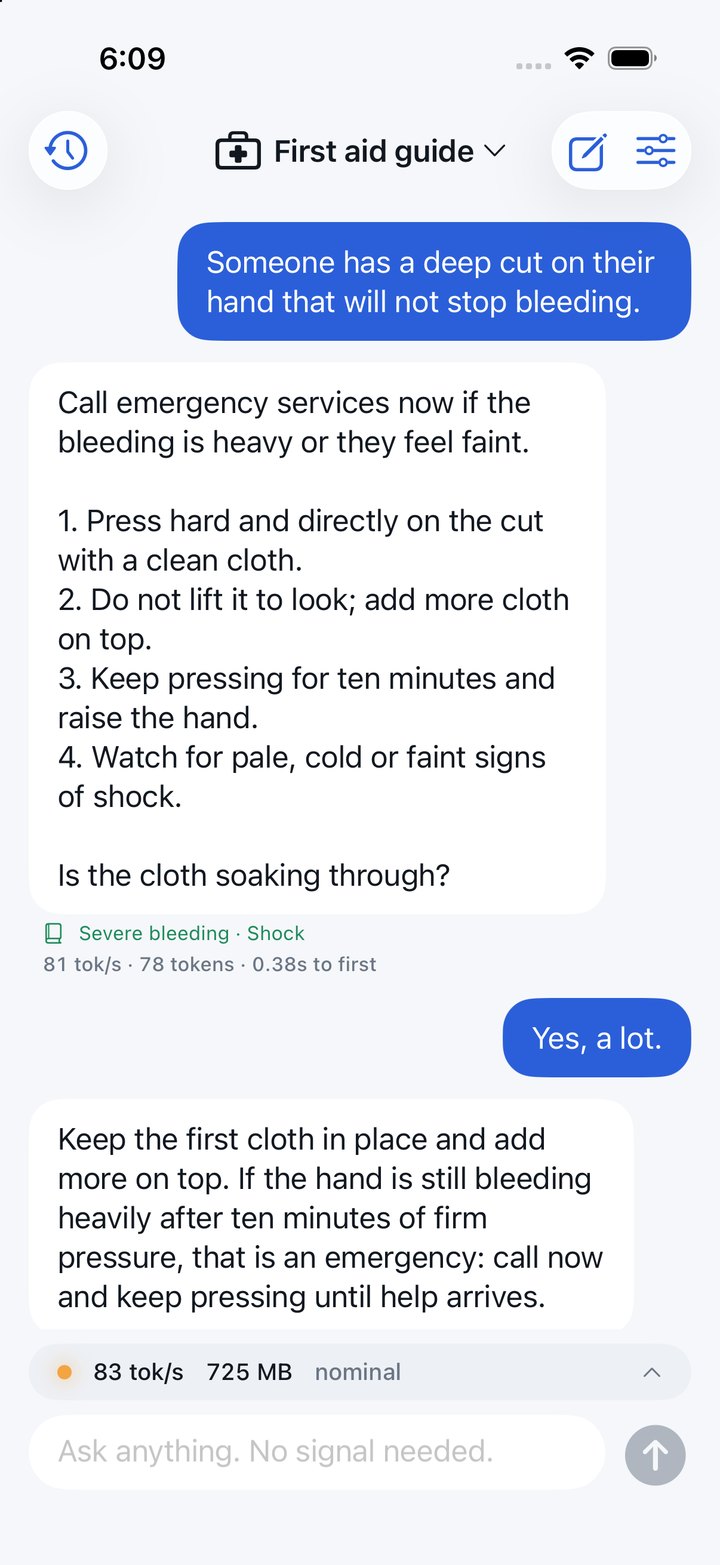
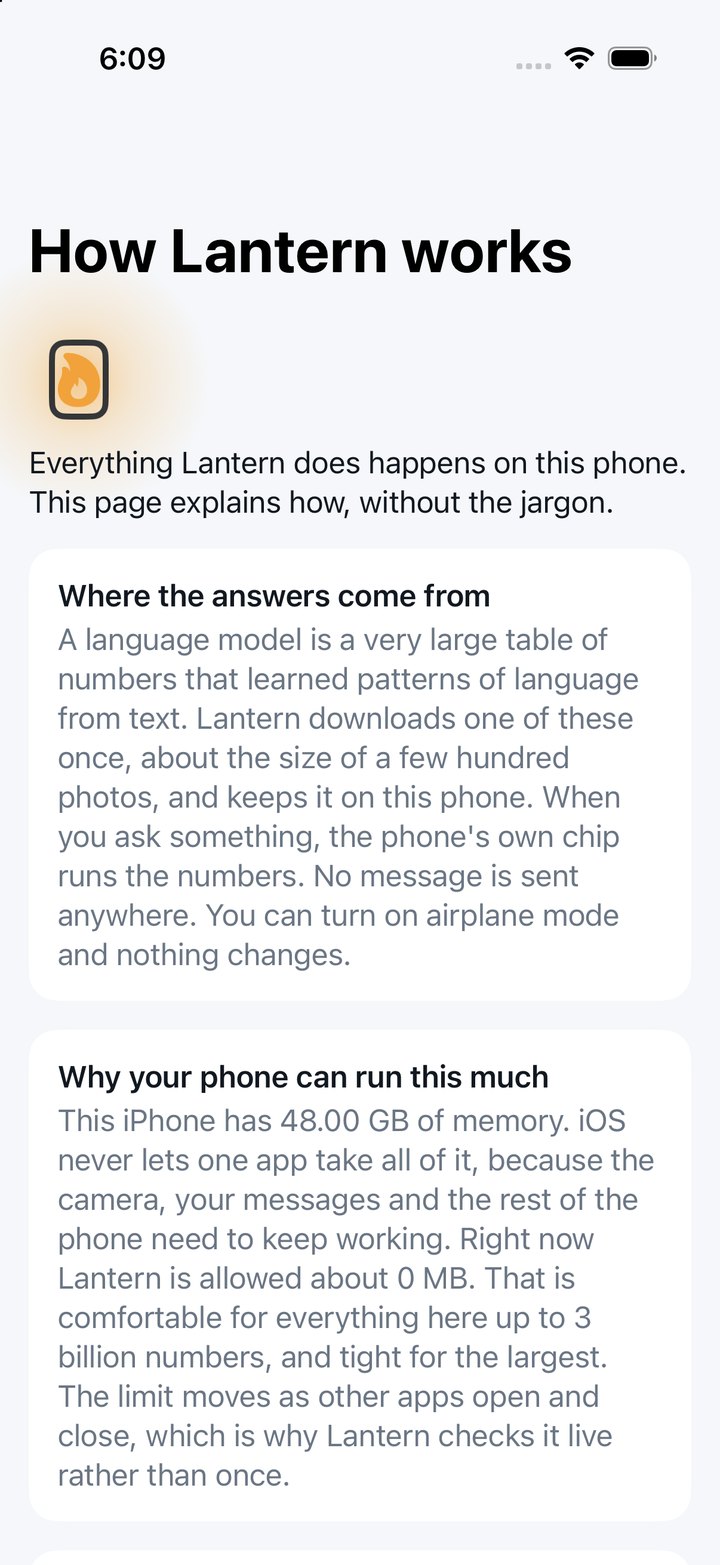
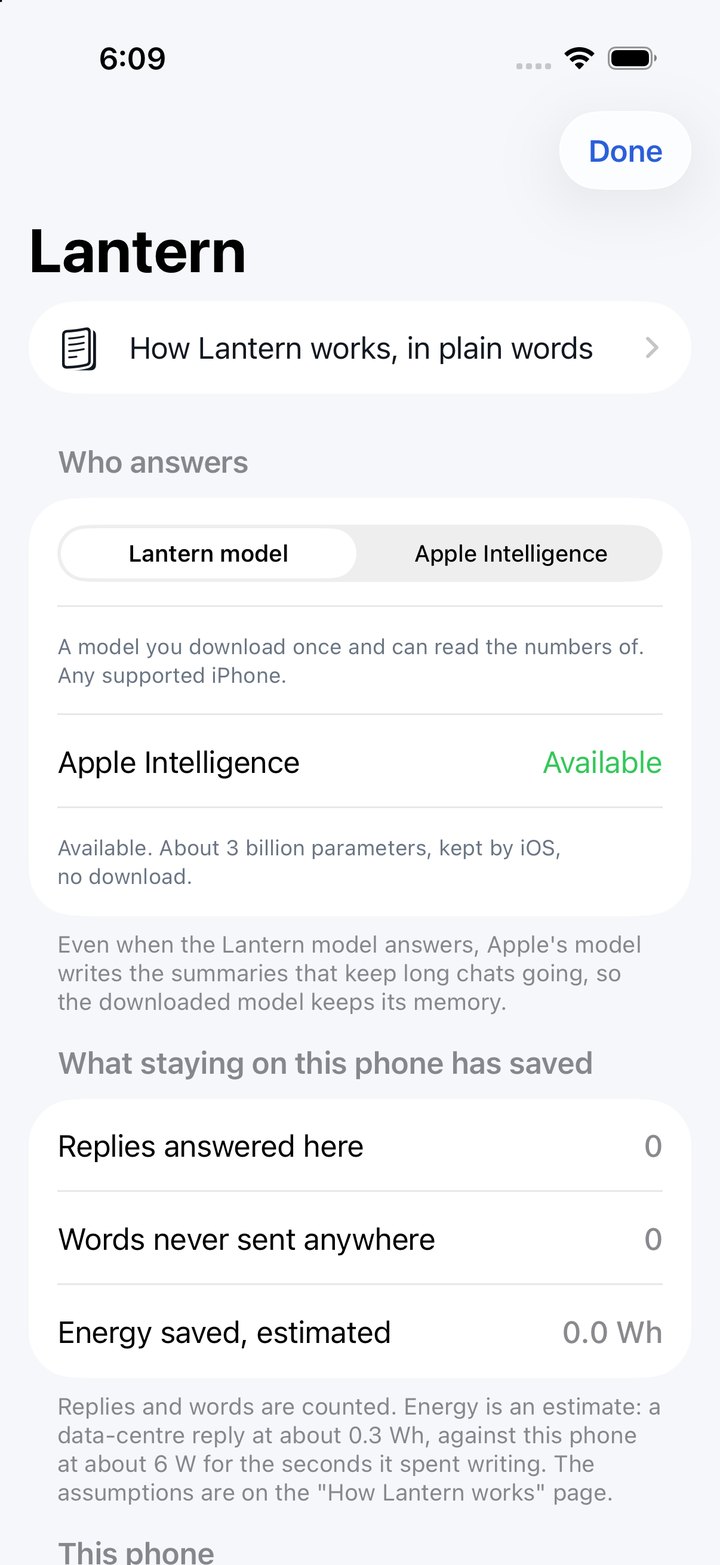
The part I am most careful about is the gate. Before anything downloads, the app reads the phone's memory, how much this process is still allowed to allocate, free disk, and whether the GPU is present, and then tells you per model: go, go with a warning, or not on this phone. A small model is the default and runs on four gigabyte phones. Bigger ones are offered with warnings where they belong and not at all where they would just crash. A lantern that sets your house on fire is not a lantern.
Learning by building
I will be straight about the other reason this exists. I got a new MacBook, I have been learning MLX and reading everything I can find about on device models, and this is how I learn: I make the thing. Reading about quantisation and reading about memory pressure is one kind of knowing. Watching a three billion parameter model get killed on a six gigabyte phone because I let the context grow is a different kind, and it is the kind that sticks.
Lantern is one of those projects. It is me finding out what the phone can actually hold, and it will keep changing as I keep learning.
The name
A lantern is what you reach for when the light goes out. It does not care why it went out. It does not care whether the grid is overloaded or the bill was not paid or a storm took the line. It works because it is yours and it is already in the house.
So the question the app is really asking is this. If, for whatever reason, AI goes dark, the service is down, the connection is gone, the price goes up, the policy changes, the building overheats, what could be our lantern? What is the small, dependable version that is already on the phone and does not need anyone's permission to turn on?
We have a lot of devices now. They are not scarce any more. The open question, and I do not think it is settled, is whether we really have to run enormous centers and burn that much heat to answer questions that a thing in your pocket could answer on its own.
I am going to keep learning and keep finding out what the devices can do. This one is a light. It is small. It works when nothing else does.